

Your muscles run on 3 separate energy systems, and each one has a different fuel source, a different ceiling, and a completely different response to training.
Easy miles feel manageable for hours because your aerobic system handles them with minimal waste.
Push to race effort and you’re demanding energy faster than your body can cleanly supply it, which is why hard pace falls apart in minutes.
Here’s what you’ll learn:
- How the 3 energy systems produce ATP and what limits each one
- Which system dominates your sprints, threshold runs, and long runs
- Why even a hard 800m race is mostly aerobic
- How to structure training so all 3 systems improve together
What Are the 3 Energy Systems in Running?
Every muscle contraction requires adenosine triphosphate (ATP), the only form of energy your muscles can directly use.
Your body stores very little ATP at any given moment, so it constantly rebuilds it using one of 3 metabolic pathways.
| Energy System | Primary Fuel | Duration | Oxygen Required? | Example Effort |
|---|---|---|---|---|
| ATP-PCr (Phosphagen) | Creatine phosphate | 0–10 seconds | No | 60m sprint, surge start |
| Glycolytic (Anaerobic) | Muscle glycogen / blood glucose | 10 sec–2 min | No | 800m race, fast 400m repeat |
| Aerobic (Oxidative) | Carbohydrates, fat, protein | 2+ minutes | Yes | 5K, half marathon, marathon |
All 3 systems run simultaneously during every run, but which one contributes the most shifts based on intensity and duration.
Each system has a different ramp-up speed, a different fuel efficiency, and a different recovery timeline after hard efforts.
How Does the ATP-PCr System Work?
The ATP-PCr system (also called the phosphagen system) is your fastest available energy source.
It uses creatine phosphate stored directly in your muscle cells to regenerate ATP in milliseconds, with no oxygen required and no waste products to manage.
Research has shown that creatine phosphate stores in skeletal muscle deplete within 8 to 10 seconds of maximal effort and require 3 to 5 minutes of rest to fully recover.

This system fires first at the start of every race, on every sudden surge, and during explosive hill sprints.
Once creatine phosphate runs out, your body shifts to glycolysis to keep producing energy.
That hard ceiling is why a 10-second stride feels completely different from a 400m repeat: you’re drawing on an entirely different fuel supply.
Training the ATP-PCr system through brief, all-out efforts builds neuromuscular power and improves running economy at every pace.
Strides (15 to 20 seconds, accelerating to near-max) and short hill sprints (8 to 10 seconds) are the most accessible formats for distance runners.
How Does the Glycolytic System Power Your Hard Workouts?
After roughly 10 seconds of hard effort, the glycolytic system becomes the primary energy source.
It breaks down muscle glycogen and blood glucose to produce ATP through a rapid chain of chemical reactions, without requiring oxygen.
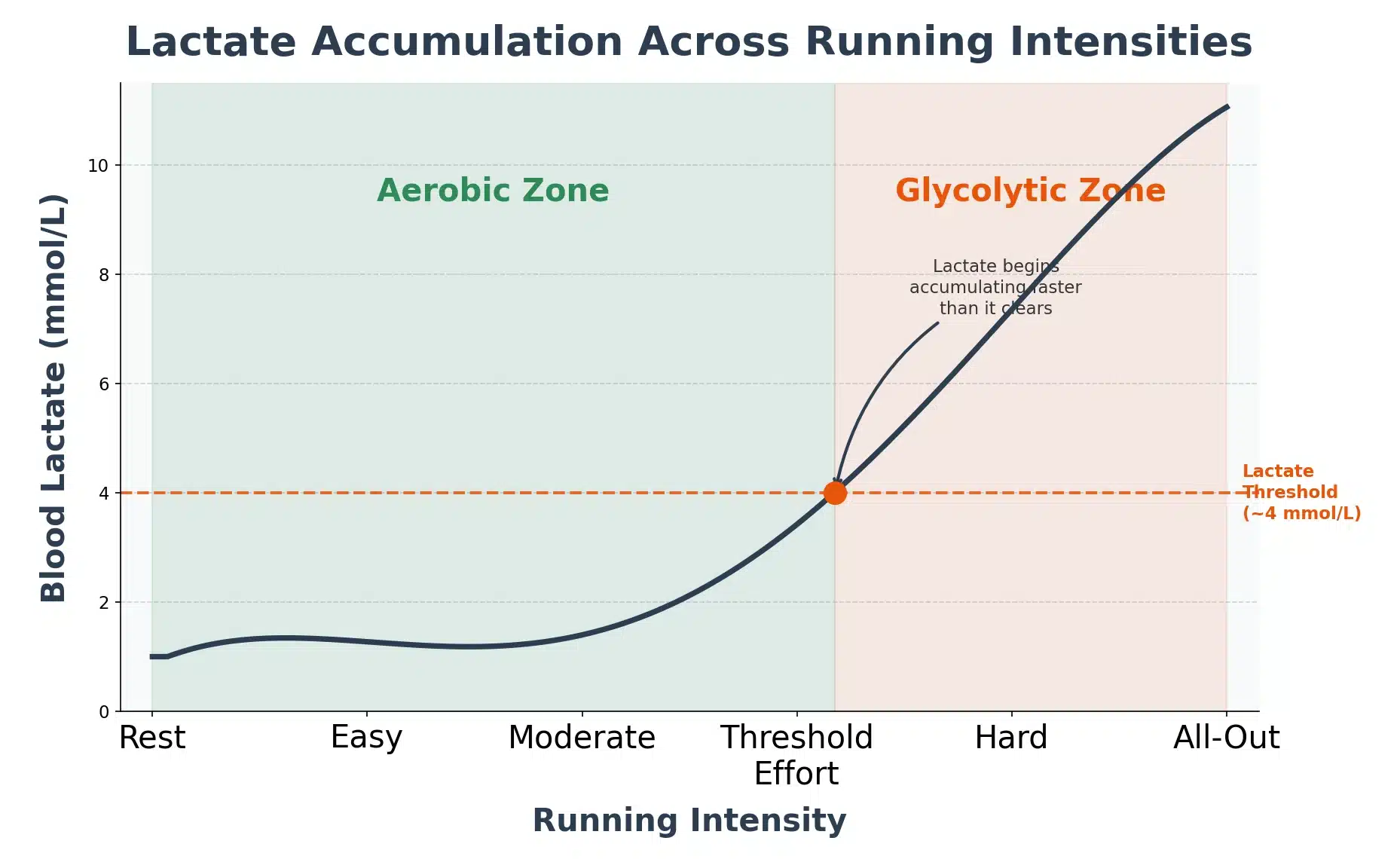
The byproduct is lactate, often mislabeled as lactic acid.
Your body uses lactate as a fuel source and converts it back to glucose in the liver.
The issue is rate.
When you push hard enough, lactate accumulates faster than your muscles and liver can clear it.
A systematic review found that lactate threshold is one of the strongest predictors of endurance performance across all distances from the mile to the marathon.
Your lactate threshold is the pace at which accumulation outpaces clearance, and raising it higher is the most direct path to faster racing at every road distance.
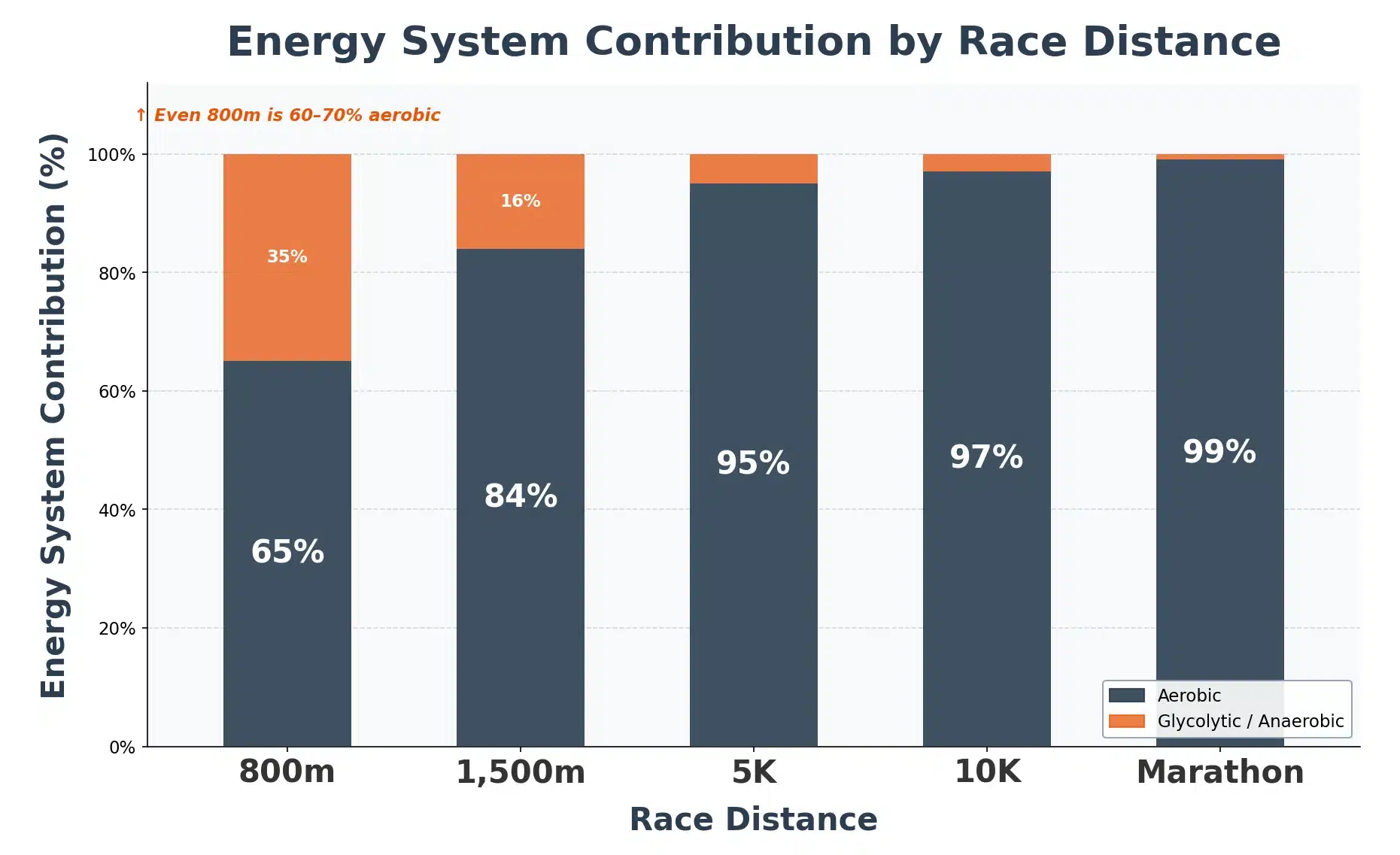
800m and mile races draw 50 to 70% of their energy from the glycolytic system, which means anaerobic conditioning matters even for runners who rarely sprint in training.
Glycolytic capacity improves through sustained high-intensity intervals: 400m to 800m repeats at 5K effort, mile repeats at 10K effort, and tempo runs that push into the accumulation zone.
RunnersConnect Bonus
Download our Heart Rate Calculator to find out what your individual heart rate zones are.
Why Is the Aerobic System the Engine of Distance Running?
The aerobic system is the dominant energy source for virtually everything distance runners do.
Given adequate oxygen, it burns carbohydrates, fat, or protein through a process called oxidative phosphorylation, primarily inside the mitochondria of your muscle cells.
Aerobic metabolism produces 36 to 38 ATP molecules from each glucose molecule, compared to just 2 to 3 from anaerobic glycolysis.
That efficiency advantage is why the aerobic system sustains effort for hours where glycolysis runs out in minutes.
The tradeoff is startup speed.
The aerobic system takes 1 to 2 minutes to fully activate, which is why the first minute of a hard run still leans on glycolysis even at paces you could hold for miles.
At easy to moderate intensities, the aerobic system burns fat as its primary fuel.
Even lean runners carry enough stored fat to fuel 20 or more hours of easy running, which is why fat oxidation determines so much of marathon and ultra performance.
The efficiency of your aerobic system depends directly on mitochondrial density: how many mitochondria your muscle cells contain and how well they convert oxygen into energy.
Consistent aerobic training is the primary driver of mitochondrial development, and mitochondrial density is the cellular mechanism behind every aerobic fitness gain you’ve ever made.
What Percentage of Running Is Actually Aerobic?
Most runners underestimate how aerobic their sport really is.
Even events that feel intensely anaerobic are overwhelmingly powered by the aerobic system.
Research has shown that a 1500m race run by highly trained athletes derives approximately 84% of its energy from the aerobic system.
A 5K at race pace is roughly 95% aerobic, even though it feels like sustained hard effort the entire way.
An 800m race still draws 60 to 70% of its energy from the aerobic system.
A marathon is 99% or more aerobic.
These percentages shift higher as fitness improves, as pace slows, and as race distance increases.
They explain why aerobic base work, done consistently over months and years, creates improvements no short-term high-intensity block can replicate.
How Do All 3 Energy Systems Work Together in a Race?
During an actual race, the 3 systems hand off smoothly rather than switching in isolation.
At the starting gun, the ATP-PCr system fires first as you accelerate from standing to race pace.
Within 10 to 15 seconds, glycolysis ramps up to bridge the gap.
The aerobic system builds over the first 1 to 2 minutes until it takes over the majority of the energy load.
This is why the opening minute of a hard race always feels harder than the middle miles at the same pace: the aerobic system hasn’t fully engaged yet.
Effort level also shifts the balance mid-race.
Surge to a faster pace and glycolytic contribution spikes immediately.
Settle back into rhythm and the aerobic system reasserts dominance.
A steady early pace almost always produces a stronger finish than going out hard, because it keeps glycolytic demand lower for longer and preserves more capacity for the final mile.
How Do You Train Each Energy System?
Each energy system responds to specific training stimuli, which is why variety in your training week exists for reasons beyond just accumulating mileage.
How Do You Train the ATP-PCr System?
Short, all-out efforts of 8 to 10 seconds build ATP-PCr capacity and neuromuscular efficiency.
Strides (15 to 20 seconds, accelerating to near-maximum) and short hill sprints are the most accessible formats for distance runners.
Full recovery between each effort is required: 2 to 3 minutes of walking or easy jogging before the next rep.
The ATP-PCr system needs that time to replenish creatine phosphate stores.
Cutting rest short means the next effort recruits glycolysis instead, which is a completely different training stimulus.
How Do You Train the Glycolytic System?
Sustained high-intensity intervals stress the glycolytic system and push your lactate threshold higher.
400m to 800m repeats at 5K effort, mile repeats at 10K effort, and tempo runs at lactate threshold pace all target this pathway directly.
These sessions should feel controlled-hard rather than all-out: the goal is working at or just above the accumulation point, where lactate is rising but not yet spiraling.
Glycolytic workouts typically need 48 hours of recovery before the next hard session.
What Builds Aerobic System Fitness?
Easy runs, long runs, and aerobic threshold work all build aerobic capacity through the same core mechanism: mitochondrial development in your muscle cells.
Consistent easy miles are the primary driver of mitochondrial growth.
Long runs extend the duration of aerobic stress and improve your body’s ability to burn fat at race-relevant paces.
The most effective endurance programs spend roughly 80% of weekly training volume at easy aerobic intensities, reserving 15 to 20% for structured high-intensity sessions targeting the glycolytic and ATP-PCr pathways.
Running easy days at a pace that tips into glycolytic contribution blunts mitochondrial adaptation and extends recovery time between hard sessions.
That pattern catches runners in a middle zone where hard workouts feel sluggish and easy days feel taxing.
| System | Best Workout Type | Effort | Recovery Needed |
|---|



3 Responses
Great!!!
Very good information and user friendly. I am a keen runner and enjoy understanding what’s happening in my body when I run and how best to replenish what energy I have used and how?
thank you for the post it has really helped me understand the lactate acid formation, keep it up please